
Pause before deciding what the silence means
A quiet room does not tell you, by itself, why people are quiet. The question may be unclear, the topic may feel too personal, or someone may need more time to put an answer into words. Avoid announcing that the group is unmotivated or unwilling.
Give the question a little space. Then check whether everyone heard and understood it. SAMHSA’s guidance on group leadership notes that language processing can affect how quickly someone responds. It also emphasizes attending to what is happening rather than treating every quiet moment the same way. See TIP 41, Chapter 6, “Silence.”
Use the context you know about your group. A planned educational discussion and a process group may call for different responses. These options are for a facilitator considering the next step in an adult educational or skills group.
Make the question easier to enter
“Any thoughts?” leaves people to work out what kind of answer you want. Try asking about one part of the example you just used.
During a group about asking for help:
“What would make this request easier for the other person to understand?”
If that is still too open, offer a starting point: “We know the person wants help. Do we know what they are asking someone to do?”
Ask one question and wait for that answer. Several questions in a row can make it harder to know which one to respond to.
When someone offers a response, stay with it long enough to make it useful. If they say, “Be specific,” you might ask, “What could that sound like in this example?” There is no need to move immediately to another volunteer.
Offer another way to take part
Keep the task connected to the lesson. Depending on your group, you could:
- Read two possible responses and invite people to compare them.
- Demonstrate a short answer, then ask what someone might keep or change.
- Offer a moment to think or write before inviting volunteers.
- Let people work with a fictional person instead of describing their own experience.
Make it clear that people can listen or pass where appropriate to the setting. Do not turn the exercise into a demand for private disclosures. Choice and collaboration are principles in SAMHSA’s TIP 57, “Support Control, Choice, and Autonomy.”
If nobody volunteers, you can discuss the example yourself and move to the next planned step. A quiet activity can still have a clear ending; it does not need to become a contest to get everyone talking.
Know when a different response is needed
If the silence follows conflict, visible distress, or a disclosure that needs attention, a lighter question may not address the concern. Follow your setting’s procedures and use appropriate supervision or private support. Do not ask the room to explain another person’s reaction.
After group, review the task you offered. Was the question understandable? Did it require personal information that was not necessary? Was there time to think? Those are concrete things you can adjust before the next session.
Keep guidance nearby while you lead
GroupReady’s Facilitator Mode keeps the session sequence in view. More Guidance explains the purpose of a step, what to listen for, and ways to connect the discussion. Group Is Stuck includes guidance for moments such as nobody talking.
Start with Acceptance or Boundaries, the two complete groups included free. Each has 30- and 60-minute sessions, matching printable materials, and Facilitator Mode. GroupReady is available in the U.S. for iPhone and iPad.
Explore Facilitator Mode before choosing a session for your group.
Download on the App Store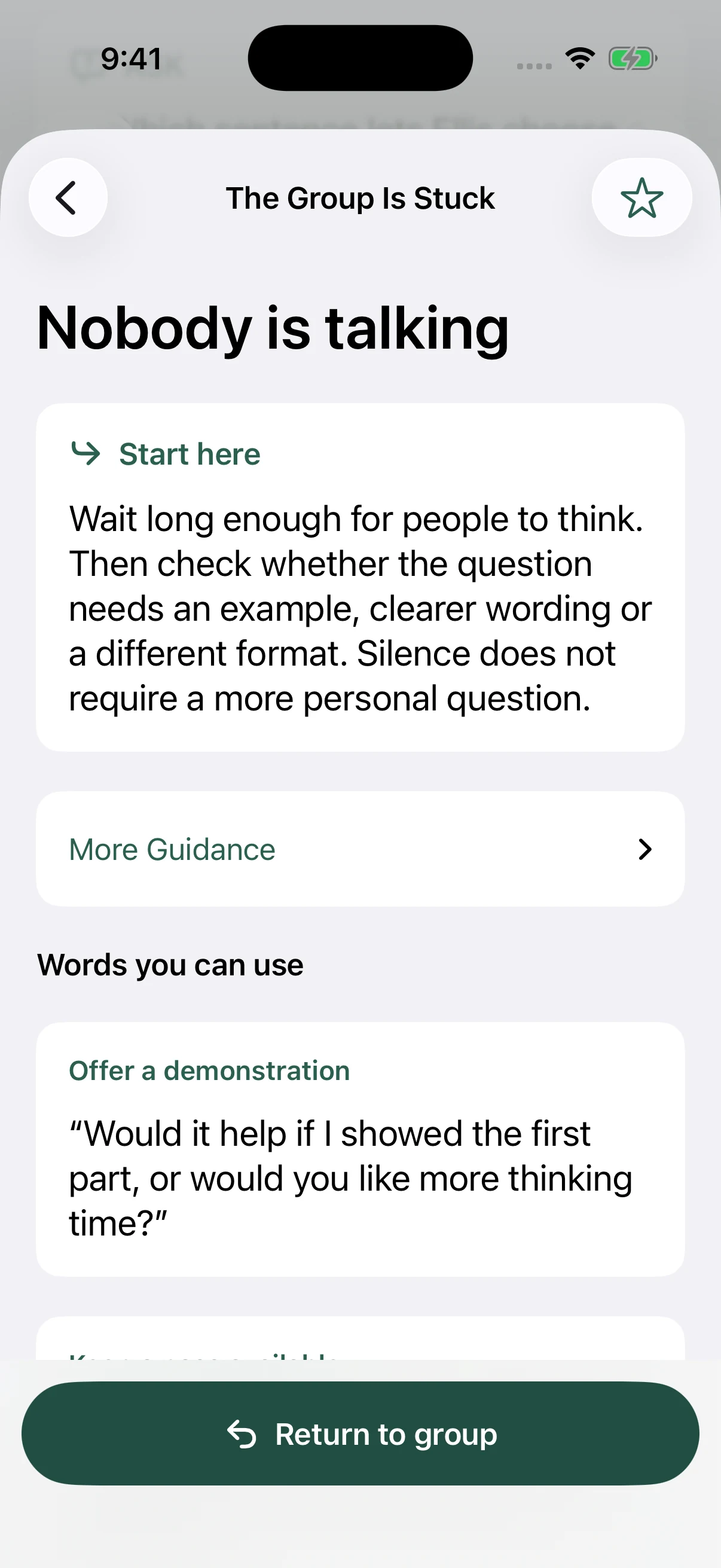
More help for your next group
Published October 8, 2026 · GroupReady