
Choose one thing to work on
Start with what the group is there to do. “Recovery” is too broad to plan around in half an hour. A more workable focus might be asking for support, responding to a change in plans, or saying no to one request.
Write the goal in a sentence you could say aloud. For a group about asking for support, that could be: “Today we’ll think about what makes asking difficult and practice making one request clearer.” The goal gives you a way to decide which examples and questions belong.
Check that the topic fits the people attending, your role, and the program’s plan. Supervised trainees should confirm that fit with their supervisor. A short educational group is one part of care; it does not replace assessment or the treatment your setting provides.
SAMHSA describes psychoeducational groups as structured groups that connect information to participants’ lives, often using a prepared curriculum. That supports planning for both explanation and discussion. Read TIP 41, Chapter 2.
Give each part a job
Here is one possible planning outline. These times are an example to adapt, not a required format or a tested treatment protocol.
- Opening — 3 minutes. Name the focus, explain participation choices, and give people a straightforward way to begin.
- Explain the idea — 5 minutes. Introduce one useful distinction with a brief example. For asking for support, compare “I need help” with a request that tells the listener what help is wanted.
- Work with an example — 10 minutes. Let people compare wording, consider a response, or practice a short exchange. Make listening or using the example a valid way to take part.
- Discuss what came up — 8 minutes. Explore what made the request clearer and what could still make asking difficult. Leave room for the possibility that the other person cannot help.
- Close — 4 minutes. Return to the main idea, invite one takeaway, and remind people how to seek further support in your setting.
If the discussion needs more time, hear fewer examples rather than adding another exercise. Keep the closing in the plan.
Check the details before people arrive
- Read the whole plan, including the closing and any safety guidance.
- Check that the handout belongs to the topic and session length you selected.
- Read the first instruction aloud. If it needs explaining, decide how you will introduce it.
- Have a way to lead without printing: read the example, demonstrate the task, or let people think privately.
- Know who is available for private follow-up and how to contact them.
Choose one backup prompt. If “What gets in the way of asking?” is too broad, try “What might someone worry the other person will say?” You are giving the group a clearer place to start, not adding a second topic.
Use a complete session when you need one
In GroupReady, choose a topic and its 30-minute version. Review the Facilitator Guide, prepare the matching Participant Handout, and use the printed guide or Facilitator Mode while leading. The 60-minute version is available separately when you have more time.
Acceptance and Boundaries are included free, with both session lengths, facilitator guidance, and their printable materials. The app is available in the U.S. for iPhone and iPad.
See the preparation-to-leading workflow, or open the app to review a complete free session.
Download on the App Store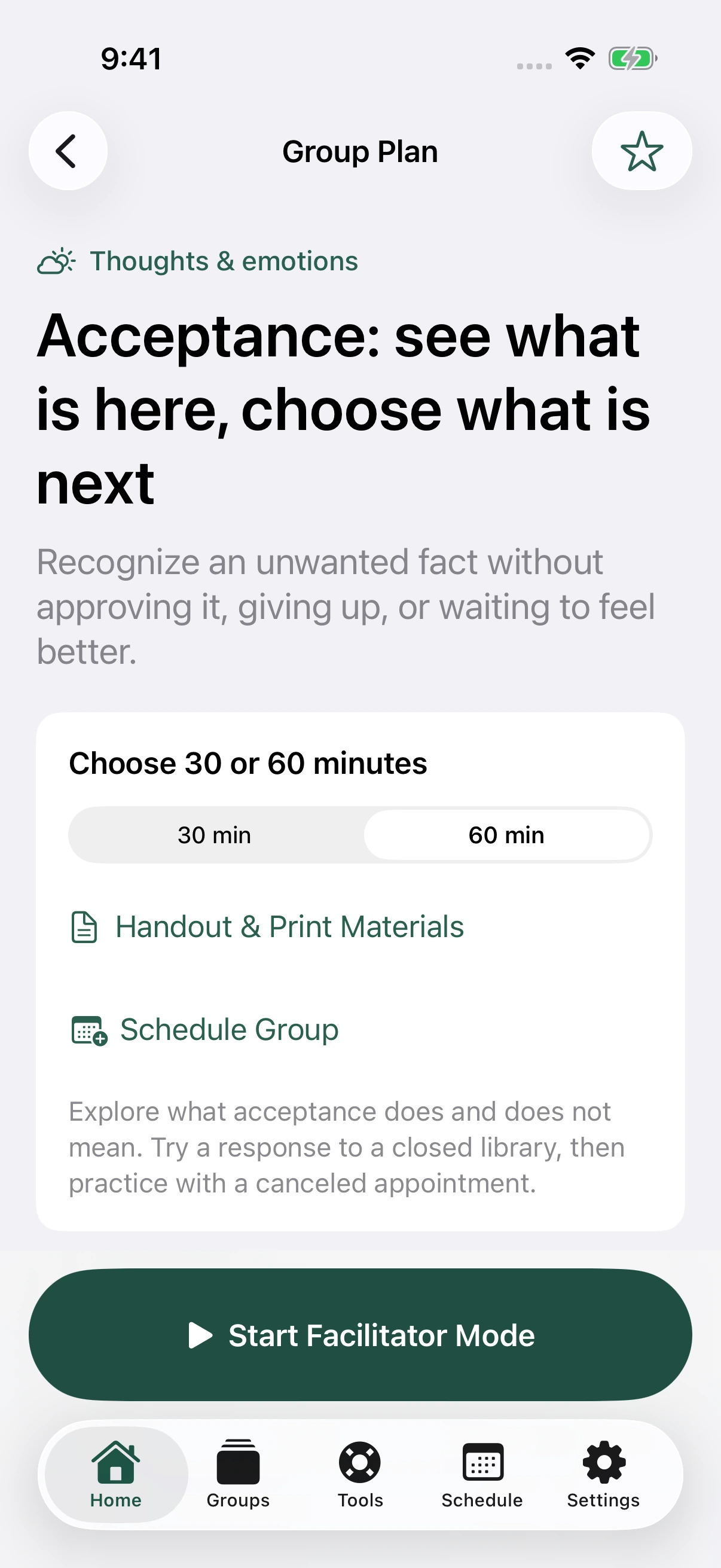
The outline above is a website planning example. It is not the timing of the Acceptance session shown in the app screenshot.
More help for your next group
Published October 8, 2026 · GroupReady